
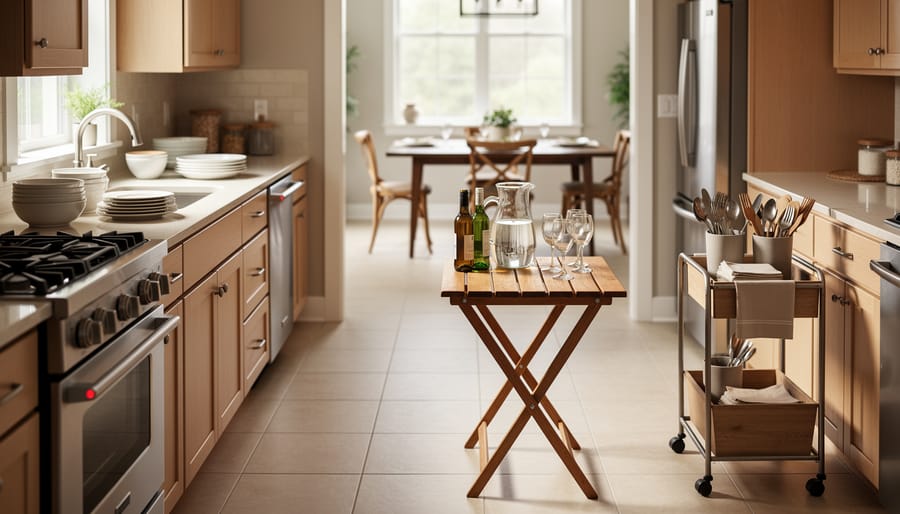

Turning your Kitchener kitchen into a hosting-ready space for festival season and big family dinners takes about an afternoon and a little rearranging, no renovation needed. The method is simple: clear one main path through the room, set up separate zones for cooking, serving, and drinks, and move the crowd away from the stove. That’s it. When guests have somewhere to stand that isn’t in the cook’s way, dinner runs smoother and everyone relaxes.
Why does it work? Most hosting stress comes from traffic jams, not from the food. Picture a galley kitchen with ten relatives reaching past the cutting board for a drink, or an open-concept condo where the serving dishes have nowhere to land. A few smart changes fix both.
Below, we’ll cover what you need on hand, the safety checks worth doing before the doors open, and step-by-step layouts for galley, open-concept, and compact kitchens. We’ll also share a few behind-the-scenes lessons from festival-season hosting that apply just as well at your own table. Visiting for the season and cooking in a rental? You’re welcome here too.
What You Need Before You Rearrange: Tools and Materials for a Hosting-Ready Kitchen
You don’t need a renovation budget to get a kitchen ready for a crowd. A handful of simple supplies, most of them easy to find at local hardware and home stores, will do the job. Here’s what to gather before you move anything:
- A tape measure, so you can check walkway widths and table sizes.
- Painter’s tape to map out prep, cook, serve, and clean-up zones on the floor and counters.
- A rolling cart to act as a movable prep station or serving hub.
- A folding table to extend your serving line.
- Shelf risers to double your cupboard and counter space.
- Labelled bins to corral gear you’ll want out of the way but within reach.
- Power bars and extension cords for slow cookers and warming trays.
- Extra serving dishes and utensils so nobody waits for a turn.
- Trivets to protect counters and tables from hot dishes.
Painter’s tape is the real hero here. It lets you test a layout before you commit, and it peels off cleanly when the party’s over. If your plans grow bigger than a weekend shuffle, Paul’s team at PD Home Renovations can help you think through longer-term changes, but everything above works on its own.
A quick note on how we chose the layouts in this guide: we looked at real home kitchens of different sizes, from snug galley kitchens to open-concept spaces, and focused on setups that hold up for 8 to 20 guests. Whatever your kitchen looks like, there’s an approach here that fits.
Before You Start: Safety Warnings and Stop Points
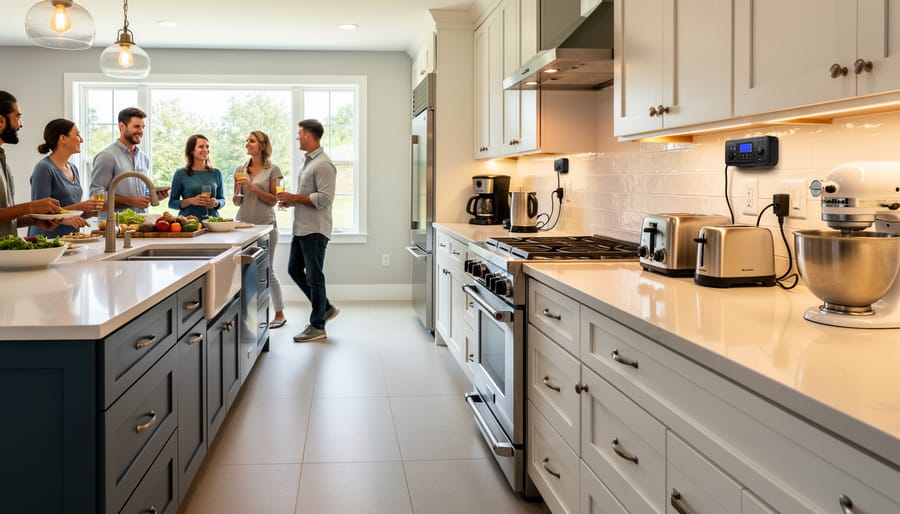
A crowded kitchen can still be a calm one. A few quick checks keep everyone safe, so you can stay festive and safe while the pots are bubbling and the guests keep arriving.
Start with the floor. Tuck cords out of walkways and lift any loose rugs that could catch a toe. Keep hot pots and roasting pans away from the main traffic path, ideally on the back burners or a counter with some breathing room. Set up a kids’ and guests’ zone, like a snack table or a corner by the dining room, well away from the stove so little helpers have a fun spot of their own.
Spread out your appliances. Slow cookers, warming trays and kettles all pull real power, so don’t plug them all into one outlet or power bar. Keep the fire extinguisher where you can grab it, and make sure exits are never blocked by chairs or coolers. With food, keep hot dishes hot and cold dishes cold, and don’t leave anything sitting out for more than two hours.
Pause your setup if any walkway is narrower than 90 cm, or if anything feels hot, smells odd or sparks. Fix it first, then carry on.
Step-by-Step: Turning Your Kitchen into a Crowd-Friendly Space
Small Kitchens and Galley Layouts: Making Every Metre Count
A narrow kitchen can still feed a crowd if you stop asking it to do everything at once. Start by borrowing floor space. A rolling cart parked beside the counter becomes a temporary island for chopping or plating, and it rolls away when you need the walkway back.
Next, move the serving out of the kitchen. Set the dining table or a hallway console as your buffet, so guests grab their plates without squeezing past the cooks. In a galley, that single change clears the biggest traffic jam.
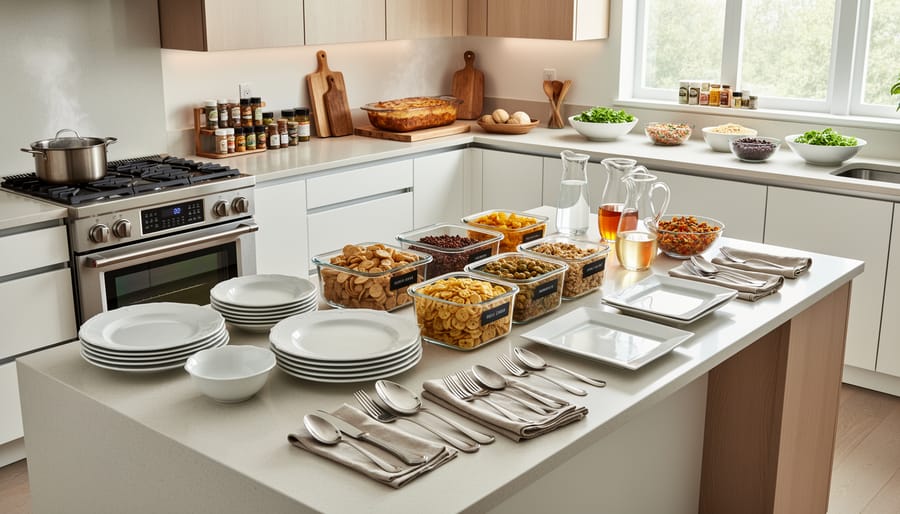
Prep ahead wherever you can. Chop vegetables, mix sauces and portion desserts the day before, then store them in labelled containers on shelf risers so the fridge stays easy to scan.
Finally, stagger the work. In a galley, one or two cooks is the comfortable limit, so give each person a clear task and a time window. One person handles the stovetop while another assembles salads at the cart, and everyone else keeps conversation and drinks flowing in the next room. It’s a small shift, but it keeps the kitchen calm when the doorbell starts ringing.
Open-Concept and Island Layouts: Letting the Party Flow
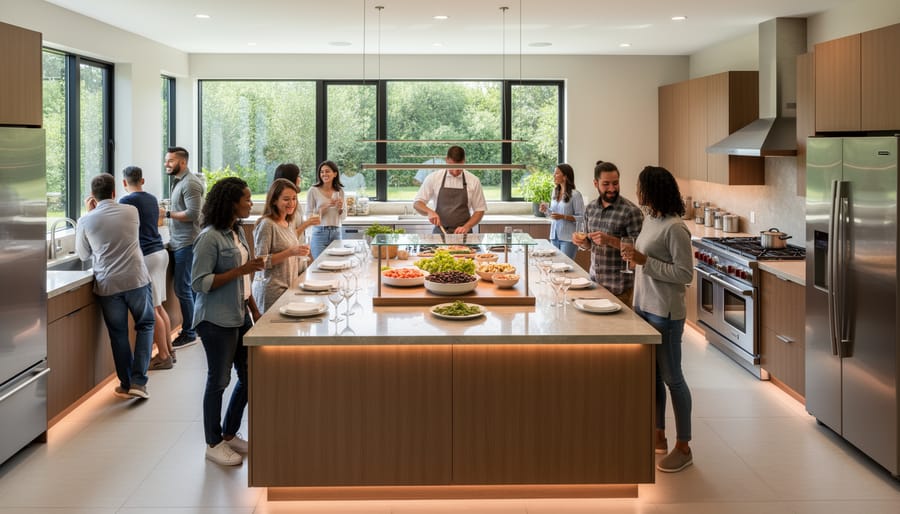
If you have an island, let it do the heavy lifting as your serving hub. Set out plates, napkins, and the main dishes along one side so guests can circle through and move on, rather than clustering around the stove. Think of it as a buffet line with a built-in flow.
Next, give your kitchen a social side and a working side. Keep the cooktop, oven, and sink on the working side, and place stools, drinks, and nibbles on the other. A runner of snacks at the far end draws chatty guests away from the hot pans, and everyone still feels part of the action. A simple strip of painter’s tape on the floor can mark where the cooks work.
Festival hosts know the magic of an open-door, drop-in spirit, so leave room for people to wander in, grab a plate, and pitch in. Long evenings of cooking and hosting call for some multi-day festival stamina of your own, so keep a comfy spot or two for tired cooks to sit and join the conversation.
Kitchens That Open to a Dining Room or Basement Rec Room
If your kitchen opens onto a dining room or has a rec room downstairs, you’ve got bonus space, so use it. The goal is to spread the crowd out so nobody is wedged between the fridge and the stove.
Set up a second beverage station in the rec room. A small table with a cooler, a kettle, mugs, cups and a jug of water keeps thirsty guests away from your cooking zone, and it gives downstairs mingling a natural centre. Put a few napkins and a small bin nearby so you’re not hauling trash up and down the stairs mid-party.
Turn the dining room into your dessert stop. Pies, cookies and tea can sit on the sideboard or a folding table placed in line with the main serving spread. Extending the line this way gives guests more room to browse and keeps the main counter from jamming up.
Finally, walk the route a dish will travel from stove to table. Clear it of chairs, bags and boots, and make sure there’s one direction of travel where possible. A clear path means hot dishes arrive safely.
Behind the Scenes: What Festival Hosts and Big-Family Cooks Do Differently
Ever notice how a busy festival food area never feels chaotic? That’s no accident. Good event coordination starts with flow: one line going in, another coming out, signs that tell people where to go, and a spot where volunteers can jump in. Bring those ideas home and your kitchen starts to feel just as smooth.
Try giving your own space the same treatment. Pick one side of the room as the “in” path for guests grabbing food and the other as the “out” path for people returning plates. Stick a handwritten sign on the cupboard that says “Cups here” or “Dessert this way.” You’ll be surprised how many questions disappear. And leave one counter open as a helper spot, so anyone who asks “Can I do anything?” has an easy answer.
Hosts who cook for big gatherings tend to share a few favourite tricks. One says, “Everyone gets a job. Even the cousins who swear they can’t cook can fill water jugs or carry out the bread.” Another swears by a “dish drop-off” station: “I set a tub and a towel by the sink so used plates have a home. It keeps the counters clear, and nobody feels like they’re in the way.”
First time hosting? Start with just one of these ideas. A single sign or a single job assignment is plenty. Your guests will be glad to pitch in, and that’s half the fun.
Check Your Setup and Plan Your Next Gathering: Verification and Next Steps
Before guests arrive, give your layout a quick dry run. Set a timer for 10 minutes and pretend the party has started: carry a tray from the stove to the serving spot, refill a drink, and clear a plate. If you bump into things, move them now, not when twelve hungry relatives are watching.
Check that two people can pass each other at the busiest points, especially near the fridge and the sink. Look at your outlets, too. If a power bar feels warm or three appliances share one plug, spread them out. Then see whether serving spoons, platters and trivets are within arm’s reach of where the food will actually sit.
Afterward, jot down what worked and what didn’t. A few notes on your phone will save you time at the next dinner, and guest feedback (“the drinks table was perfect!”) tells you what to keep. It also helps to plan ahead. Once you know when festival season starts, you can tweak your layout early and enjoy the gathering instead of scrambling.
Common Questions About Hosting Layouts for Festival Season and Family Dinners
How much counter space do I need for 15 guests?
Aim for a clear stretch of counter for the serving line, plus a separate spot for prep. If your counters can’t handle both, a folding table or rolling cart gives you the extra room without any renovation.
Can I host in a small kitchen?
Absolutely. Prep ahead, stagger the cooking so only one or two people work at a time, and move the buffet to the dining table or a hallway console.
Where should the drinks go?
Set up a self-serve drinks station away from the stove, like a side table or the basement rec room. That way guests grab a glass without crowding the cooks.
How do I keep kids out of the cooking area?
Give them a fun zone of their own, with a snack table and a few activities, on the far side of the room. Painter’s tape on the floor makes a simple “cooks only” boundary that even little ones can follow.
Still wondering about the finer points? Two quick ones. If you don’t have an island, a rolling cart or a console table does the same job as a serving hub, and it’s easy to tuck away afterward. As for timing, try setting up the day before. Do your dry run, tape out your zones, and get the cords and bins sorted, so the day of the dinner is all about the food and the company.
Every kitchen is a little different, so treat these answers as starting points. Tweak them to suit your space, your guest list, and your own style of hosting.
At the heart of every great festival and every big family dinner is the same simple joy: good food, shared with people you love. You don’t need a brand-new kitchen to make that happen. Try one or two changes this season, maybe a rolling cart for serving or a dish drop-off spot by the door, and see how much smoother the evening feels.
Then take that welcoming spirit out into the community. Explore upcoming festivals and events near you, swap hosting tips with friends and neighbours, and think about volunteering. There’s always room at the table, and the more hands we have, the merrier the gathering.